
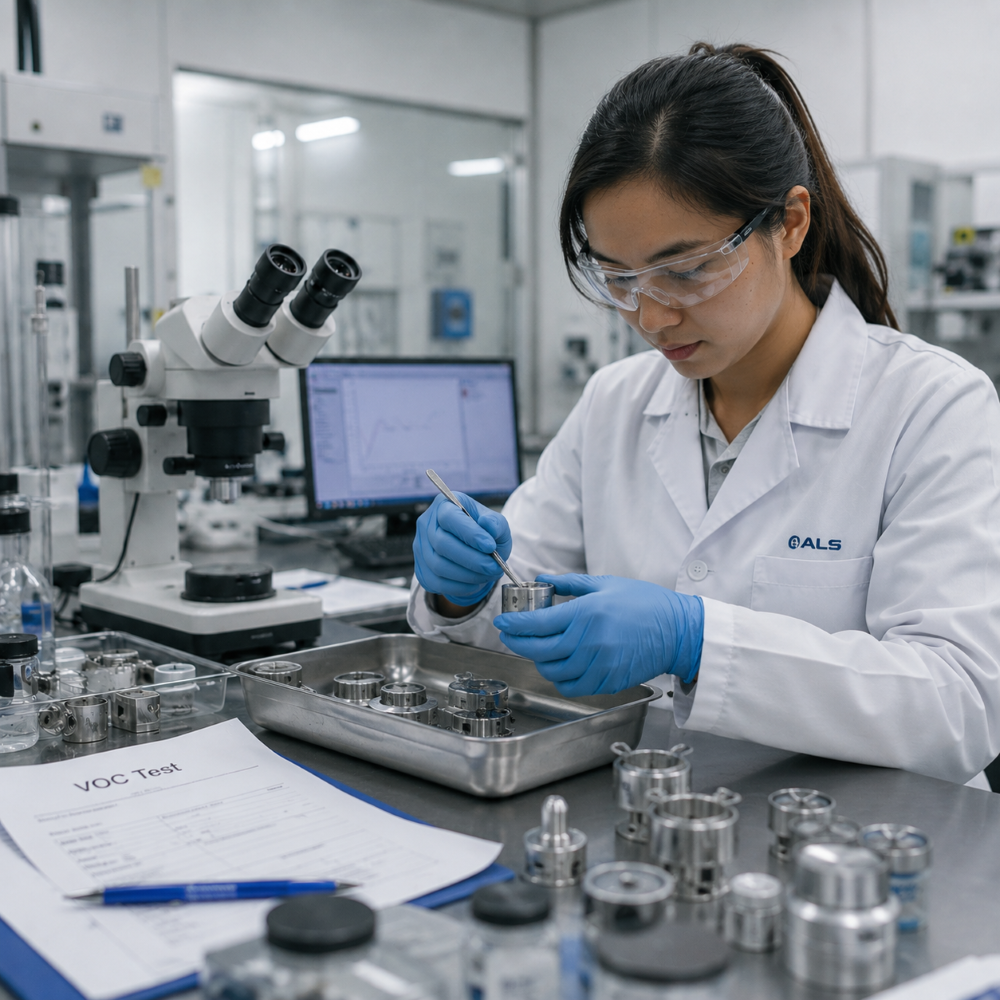
VOC Test for Automotive Interiors: What Materials Need Testing?
That familiar new-car smell comes from volatile compounds being released by plastics, foams, adhesives, coatings, textiles, and pretty much every other material inside the cabin. These emissions usually fade over time, but automotive manufacturers still need actual measurable data to confirm each material meets customer and OEM requirements before production gets approved. A VOC test looks at what compounds a material or finished component releases under set lab conditions, and which method applies depends on whether you’re testing a small material sample, a full interior component, or the air inside an assembled cabin.
What a VOC Test Actually Measures
VOC stands for volatile organic compound, a broad group of carbon-based chemicals that evaporate easily at room temperature or under mild heat. In automotive interiors, these usually come from solvents, leftover monomers, plasticizers, binder resins, adhesives, coatings, and other chemicals used during polymer or foam production. Depending on the spec, testing might report individual substances, groups of related compounds, total VOC content, semi-volatile compounds, or fogging-related substances, and formaldehyde often gets tested separately rather than folded into one overall VOC number.
Which Materials Usually Need Testing
Not every part emits the same compounds or carries the same level of concern. Materials with a large exposed surface, a complex formulation, or direct contact with cabin air usually get prioritized first during supplier qualification.
| Material | Typical emission concern | Commonly referenced method |
| Dashboard and door trim | Aromatic hydrocarbons, plasticizers | VDA 278 |
| Polyurethane seat foam | Amines, acetaldehyde, processing residues | VDA 278 |
| Headliners and textile panels | Formaldehyde from binders | VDA 278 and VDA 275 |
| Carpets and underfelt | Styrene, latex emissions, formaldehyde | VDA 278 and VDA 275 |
| Adhesives and sealants | Residual solvents and monomers | VDA 278 or customer method |
| Interior coatings and paints | Solvents and reactive diluents | VDA 278 or ISO 12219 |
The final call on what’s required usually comes from the OEM material spec, supplier quality manual, or PPAP documentation. A lab shouldn’t just pick a standard based on the material name alone, since different vehicle programs can apply different limits and test conditions to what looks like the same type of material.
VDA 278 vs ISO 12219
VDA 278 is the standard most commonly used for non-metallic interior materials. A small sample gets heated in two stages, and the released compounds are analyzed using thermal desorption combined with gas chromatography and mass spectrometry. It reports the volatile fraction separately from the higher-boiling SVOC or fogging-related fraction.
ISO 12219 covers several testing scales across its different parts. Some sections apply to individual materials and components tested in emission chambers, while ISO 12219-1 covers air measurement inside a full vehicle cabin. Since the standard has multiple parts, it’s worth confirming exactly which one applies before samples get prepared or sent in. Neither framework replaces the other, and suppliers serving both German and international OEMs often end up testing the same product against both.
From Sample Prep to the Test Report
How a sample is conditioned can change the result quite a bit. Under VDA 278, materials are typically conditioned at a set temperature and humidity before testing, so the result reflects a stabilized emission profile rather than just the initial burst of compounds from freshly made or packaged material. Sampling location also matters for layered products, since foam, adhesive, textile, and surface coating can each emit differently.
During thermal desorption, the emitted compounds get collected and run through a GC-MS system, separated, identified, and quantified. A finished report usually includes compound names, CAS numbers, concentrations, chemical groups, total values, and a comparison against the customer’s limits.
Why Materials Fail VOC Requirements
A failed result doesn’t always mean the material itself is bad. High emissions can come from incomplete curing, insufficient drying, leftover solvents, high-emission plasticizers, formaldehyde-based binders, polyurethane catalysts, or contamination picked up during conditioning and packaging.
The compound profile is what actually helps pinpoint the problem. Solvent peaks usually point back to curing conditions, plasticizer-related results often call for a formulation change, elevated formaldehyde points to the binders or resins in use, and anything unexpected can mean contamination from packaging or the storage environment.
Get the Spec Ready Before Sending Samples
Before sending a material in, it helps to give the lab the exact OEM spec, required standard, test temperature, conditioning requirement, acceptance limits, and reporting format. The sample should also be genuine production material, not a specially prepared lab version, since that can skew the result.
Manufacturers arranging a VOC test can work with ALS Testing to confirm whether the project needs VDA 278, ISO 12219, VDA 275, a fogging assessment, or an aldehyde-specific method, all carried out within an ISO/IEC 17025:2017 accredited system across Southeast Asia. ALS Testing also supports manufacturers and automotive suppliers with testing requirements for projects in Malaysia, helping teams select the appropriate standard before samples are submitted. Confirming the correct method early reduces unnecessary repeat testing and keeps validation activities aligned with customer and production timelines.


